
Mountain Futures Conference – Where the grassroots and scientists discuss
innovative interdisciplinary strategies based on nature and culture.
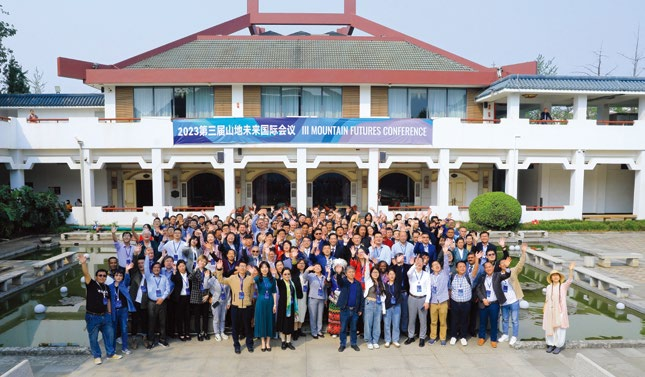
Mountains cover a quarter of the world's landmass and are home to 60 per cent of all species, and this rich biodiversity in mountainous areas is closely linked with the cultural diversity there. PCD has been supporting Kunming Institute of Botany, Chinese Academy of Sciences in organising the Mountain Futures Conference since 2016, as a way to increase awareness of the importance of mountain ecology, and to recognise the innovative value of ocal knowledge and practices in protecting biological and cultural diversity. The theme of the third conference, held in Kunming in early 2023: Mountain Communities in the Kunming-Montreal Global Biodiversity Framework. More than 200 people participated - scientists, government officials and community members from over 20 countries.
Translating the Global Biodiversity Framework into action requires the cooperation of countless stakeholders. The Conference was divided into four forums: Scientific Exploration, Ecological Restoration, Indigenous Wisdom, and Future Living. In all, there were 22 thematic speeches, 65 reports, 72 exhibitions, innovative case studies presented by community members, and cutting-edge research presented by scientists. What lively cross-disciplinary and cross-sector dialogue! Participants learned about so many things, such as using fungus to improve ecology, water and soil restoration, and carbon sequestration in agro-ecological systems. Humanities scholars also offered valuable perspectives, such as how traditional knowledge contributes to biodiversity, how the human-nature relationship is enshrined in local cosmology, and cases where local knowledge and science and technology worked hand in hand.
Conference participants viewed the knowledge and innovation of local community members as indispensable. Members shared their viewpoints with great passion, offering beliefs like: "Human beings are a part of nature", "humans and nature are like brothers" and "Awe to heaven and earth, a coexistence with nature". Local members particularly valued the Indigenous Wisdom Forum for its wide range of case studies. All 15 cases originated from mountainous communities, yet they varied significantly in terms of geographical and natural conditions, and it is these inherent differences that bring diversity to local culture and to practising local knowledge. The studies explored nature education in Dali and Lugu Lake (Yunnan), seeds preservation by Dong and Miao communities (Guizhou), forest preservation by Akha and Bulang communities (mostly in Yunnan), water source protection in Ruoergai (Sichuan), and grassland and eco-village building for climate change adaptation in Qinba Mountain Areas (Gansu, Sichuan, Shaanxi Provinces and Chongqing Municipality). This diversity of wisdom contributes to building community resilience in coping with different ecological crises.
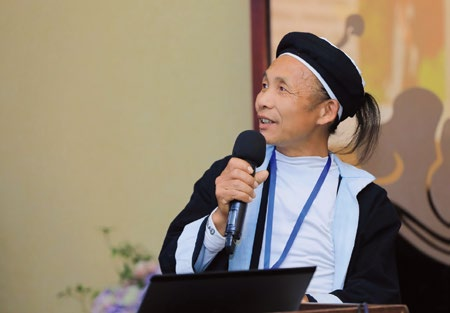
Indigenous Wisdom Sub-forum – A community practitioner shares their culture’s views of nature.
Inspiring discussions about innovative local practices went on for whole evenings! Such lively dialogue between 30-plus practitioners and seven scientists from Chinese Academy of Sciences, Sichuan University, Yunnan University and academic institutions in Germany on themes around soil restoration, local seed conservation, nature education, biodiversity and traditional culture, and artificial intelligence. The academics were keen to learn from locals, saying, "We just deepen the study of one topic, sometimes getting narrower and narrower...” "yet you are the people who know your land the best, and have the local knowledge to protect it."
Likewise, local practitioners were interested to learn how new technology, such as artificial intelligence, can be applied in ecological restoration and preservation work, such as intercropping with legumes. The two groups acknowledged their different backgrounds and different jargon, yet they identified several areas of mutual learning.
The three-day Conference was short but fruitful. Participants, whether old or new partners, locals or foreigners, were bolstered by the experience and feel even more determined to explore biodiversity conservation. The power of local wisdom resonates in their minds and hearts.