
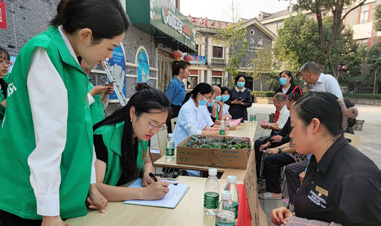
Community leaders encourage residents to engage in environmental protection.
One participant in the first phase, He Qiaola (Xiaoqiao), who founded Chengdu Qingpu Social Work Service Centre in Sichuan Province, felt she hadn’t achieved “decent results” and lost the confidence to continue. But an experienced community worker guided her, “Forget about big things. Start small, go deep. Be grounded, and follow the flow of the community.”
Encouraged, Xiaoqiao and her team rejoined and decided to work in her hometown of Heilongtan, in Sichuan Province, hoping to develop a team of local facilitators for ecological conservation. Situated along the Heilongtan Reservoir, which was built by the people of the whole county in the 1970s, the town is a typical agricultural-turned-urban community – that is, with demolition and resettlement. There also tends to be a low awareness of environmental issues and low participation in public affairs.
Despite these difficulties, Heillongtan still enjoyed social cohesion. Xiaoqiao and her community partners had come up with ideas around the pursuit of values, public spirit, cultural identity, community connection, the connection with nature, and motivation. They devised eight initiatives in all, each with its own facilitation team.
Xiaoqiao organised sharing sessions, using ‘participatory approach’ and ‘reflection’ practices that were unknown to the community and which did not yield much conversation. She then just talked casually with townsfolk, which brought forth considerable knowledge, experience, and suggestions. Through these talks, people realised that with the dissolution of rural Heilongtan life, they had become idle, which made them feel that their skills were inadequate and inconsequential, if not obsolete. They began to take a new look at their lives.
Gradually learning that most everyone in Heilongtan felt a deep affection for the land, Xiaoqiao followed the flow and shifted to land-related activities. About twenty residents joined a learning and action group, becoming “teachers” and discussing the role of plants in their local environment. Seeing their interest, Xiaoqiao shifted to asking questions: “Why can’t this plant grow? Where does the community’s garbage go, and how can we deal with it better?” The members then became “problem solvers” and went around the town, observing, seeking solutions, and maintaining regular discussions with each other through WeChat.
Organisations working towards rural sustainable living are dwindling – many are strong at running events and training sessions, but weak at nurturing personal growth. The shift from performing tasks and services to facilitating personal transformation calls for appropriate approaches, time, and patience. Xiaoqiao and the facilitation teams are exploring their path of cultivating eco-leaders. They have learned that a transformation of perspective drives the transformation of a community.