
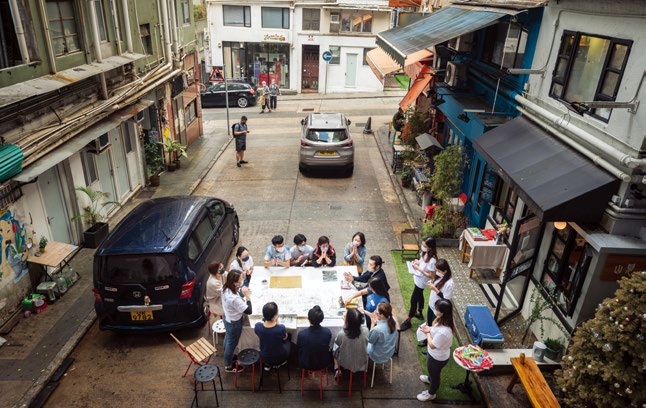
Using the community map as guides, participants learn more about and reconnect with their communities.
Sarah Mui, co-founder of One Bite Design Studio, has long been thinking about how to put sustainable living into practice. She started by taking a walk in Hong Kong’s older districts and noticed that many local shops keep potted plants. It dawned on her that she could start promoting green living through this enjoyable low threshold activity. The idea of the Community Plant Library was born.
In 2022, Hong Kong society was still suffering from the stress of the Covid pandemic. Exploring ways of relieving this stress with One Bite, PCD supported the one-year Community Plant Library scheme in Sheung Wan and Sham Shui Po: 22 local residents and community workers were recruited there as plant librarians. The librarians participated in Community Plant Mapping Workshops and Co-create Engagement Workshops, getting to know local shops in the communities, and learning to work with designers who produced plant containers or furniture for the shops.
“Many people love plants, though they tend not to say that aloud,” Sarah observed. They do however openly share their joy, experience and knowledge on social media. They are also often eager to give plants away and to tend other people’s plants.
“People may not have thought about nursing dying plants before,” Sarah said. “Instead, they might just thrown them away. Yet many people do want to rescue their plants if they can.” It is no wonder then that One Bite’s Roving Plant Clinic has been popular. They have also held Plant Adoption Days, community tree tours and cross-district meet-ups.
Different districts have different characteristics; adaptation is needed. “The Tai Ping Shan neighbourhood of Sheung Wan has a leisurely vibe – people seem willing to drop by to chat about and exchange plants. Sham Shui Po residents however do not tend to walk the streets. It is less likely that they will stop without a specific purpose. One Bite has relied on local community workers to introduce the plant library to their fellow locals,” Sarah said.
Another difference is that plant librarians in Sheung Wan are mostly adults, while in Sham Shui Po where the family is the participating unit, they tend to be children. “Many residents live in subdivided flats in Sham Shui Po. Living conditions are cramped. Kids are therefore encouraged to be outdoors tending plants rather than staying inside.” The child librarians in that neighbourhood have not only cultivated an interest in plants, but have made many friendships among themselves.
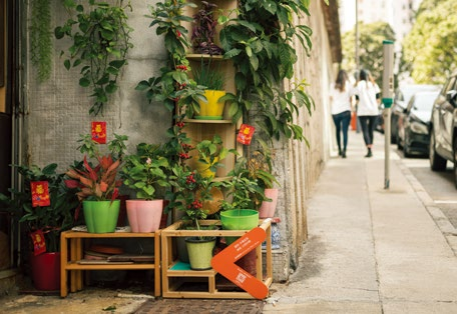
满目的社区植物,让社区的人认识、喜爱自己的社区。
The project also embraces local history. For example, during community tree tours, participants learned about the stories that come along with the neighbourhood trees. They also cherished the stories shared by local shopkeepers about the potted plants they keep. Participants come to observe the community they are visiting in a different, deeper light. This richer perspective reminds people that a place is multifaceted. Sheung Wan is not only about the historic Man Mo Temple, and Sham Shui Po offers more than chic cafés.
Sarah has come to see plants as powerful beings. They can both heal people’s hearts and enliven an entire city. They can facilitate conversations between neighbours and connect different communities.
She has seen that the Community Plant Library project has also enriched the One Bite team itself, particularly with their understanding of their home community of Sheung Wan. “We discover many plants here, growing above ground in various places. Perhaps seeds from faraway lodge into the cracks of high walls, sprouting there and growing outward. We also find many abandoned plants in back alleys.” Sarah recalls a particular site visit with a librarian who responded so conscientiously when coming across plants not receiving good care. Gardening tips are now installed next to the pots in the alley!
Although some actions may seem insignificant, gradual changes do happen. After activities ended in Sheung Wan, one plant librarian from there shifted to Sham Shui Po to offer help. The librarian has had a passion for plants ever since childhood and has accumulated extensive knowledge and experience. He now serves as a voluntary clinician, diagnosing plants for locals. He also brings along different plant species for them to adopt. Another development is that some shops have taken up hosting the Roving Plant Clinics, so locals can continue to meet up, share, and generate more ideas for action.
Connections between people and communities are like seeds. They can be scattered around, and when nurtured, will gradually flourish.