
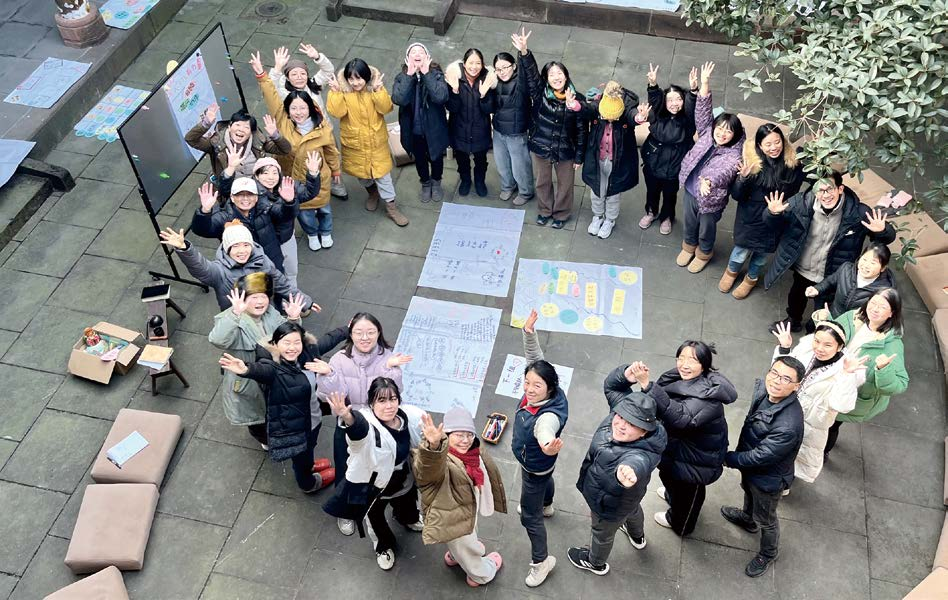
Community workers in the Theory and Methodology Co-Learning workshop.
Over the past decade, Chengdu City of Sichuan Province has implemented a policy of integrated sustainable community development in rural and urban areas, giving importance to the building of community-based organisations. Members from the philanthropic sector and individual groups of social actors have been making attempts to integrate the concept of sustainability into community living, giving rise to numerous self-organised citizen groups across the city. With the belief that community development needs to be firmly based in everyday life, we have been supporting Chengdu Action for Community Development Centre (Action for Community) since 2018. The project nurtures facilitators by combining theory and methodology for the promotion of sustainable community living. Now in its third phase, project participants include members from the philanthropic sector, workers from official sub-district and residential community offices, as well as members from local self-organised groups.
The learning of theory and methodology includes a holistic ecological worldview, self-awareness, and concepts and skills of community facilitation. Participants form small groups, identify a community, and choose a topic of interest that is relevant to their experience, such as community relations, nature education, healthy living and environmental protection. They then make needs assessments, map available local resources and design action plans for involving locals' participation. For example, Rongcheng Environmental Protection Team has been formed from nine community teams as a coalition for joint actions. The Team visits one community each month, observing and experiencing the environmental activities that have been organised, such as waste reduction and various ecological improvement efforts. They also discuss team building and practice, and promote environmental protection to enlist participation from other community teams.
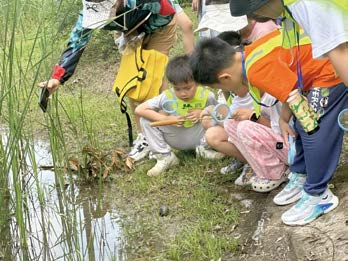
In this Nature Education Team activity in Chengdu, children and their parents
observe the characteristics and habitat of the invasive apple snail.
Nature Education Team members selected the apple snail, an invasive species originally from South America, as a topic. They recruited the participation of 12 families to promote awareness of water environment protection. Parents and children joined activities to look for apple snails in Chengdu's rivers and lakes, observing characteristics and habitat. The experience — sometimes at night — allowed them to reflect on why the invasive species problem exists, and how it is causing damage to freshwater ecosystems across China. Participants were also prompted to contemplate the role of human beings in the ecosystem. At the end of the activity, the children created a story on apple snails, including suggestions for protecting the water environment. Team members themselves gained a deeper understanding of human-nature relationships.
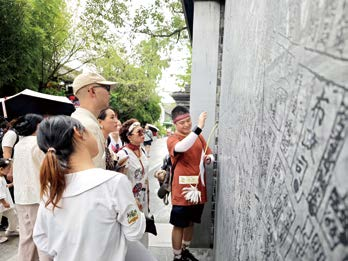
During this city walk, the Community Mapping Team invites youth to
observe and experience the community's culture and environment.
Action for Community hopes that facilitators go beyond technical aspects of facilitation and embrace underlying principles and values. By working in teams to initiate community actions for sustainable living, they also learn interpersonal relationship building and gain deeper self-knowledge — this essentially lays the foundation for the art of facilitation. Learnings accentuate participant-orientation, a principle of empowerment. For example, Community Mapping Team invited youth to join its Know Your Community in Detail workshop series. Walking the city and observing physical spaces and community facilities, youth talked with locals to learn about their everyday life, local culture and environment, and eventually produced a community walking map. About 100 participants joined, some of whom became cocreators, joining the mapping team to conduct further research.
It has taken two years for participants to learn, grow and become facilitators for sustainable living — a result of joint efforts by project teams, trainers, the learning community and the participants themselves who passionately aspired towards personal growth.