
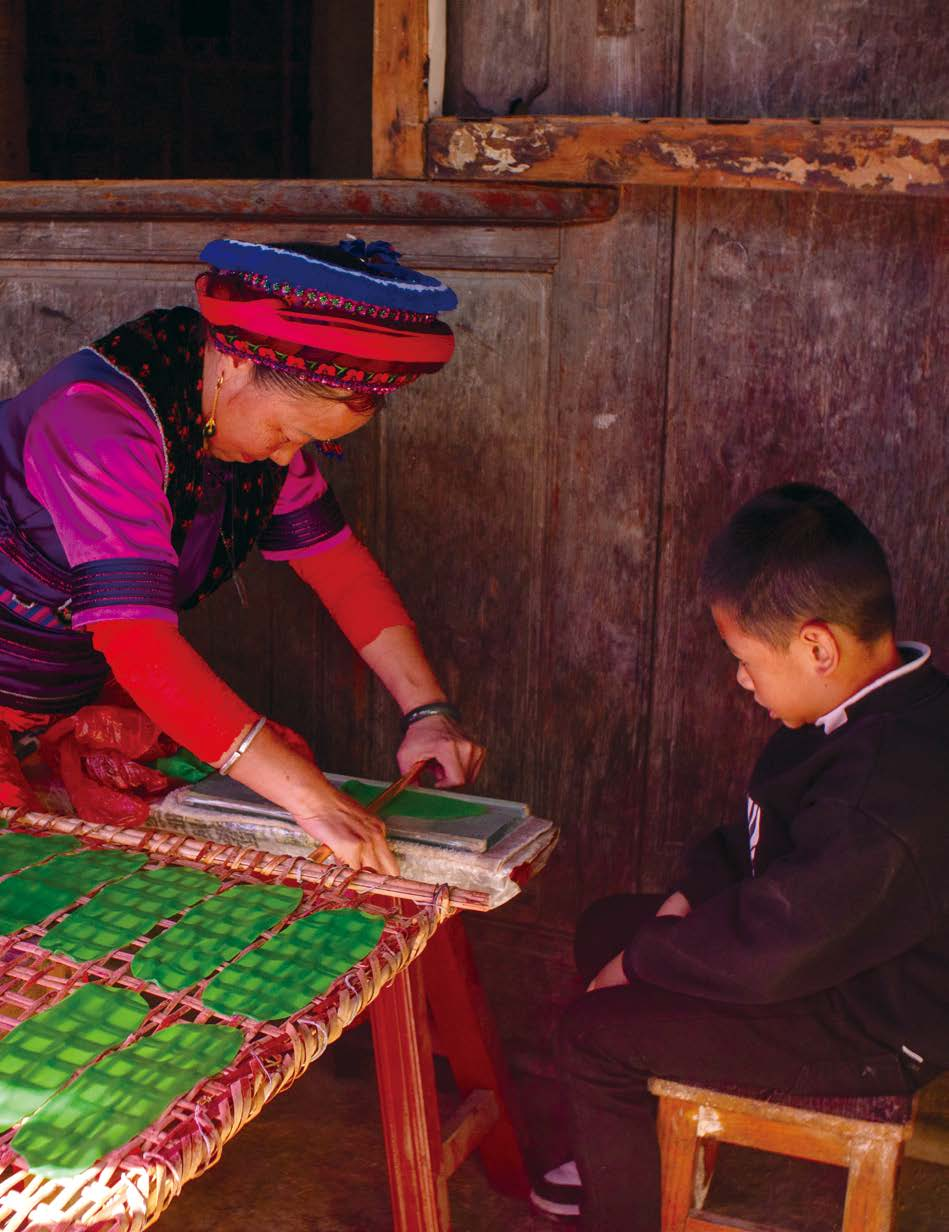
Villagers in Zhoucheng in Yunnan Province roll the dried 'orchids'
made from rice flour that they offer in worship.
Wumu Village, Yunnan Province, has an 800 year history as the home of the Naxi ethnic group. Traditional culture here gives centrality to cooperation and a sense of kinship and reciprocity with all beings. Many ancient mechanisms for mutual help exist, such as the Sanduo Festival, a time to worship the god of war, Sanduo, and a time to donate. This generosity has maintained a charity granary storehouse for villagers in need. The entire Wumu community has also cared for its elderly, with food, health care and companionship. Even though local water resources are often scarce, effective systems have been in place for equitable and cooperative division of labour, distribution and water management. All in all, Wumu has been able to thrive and maintain ecological balance.
Recent economic development in adjacent areas and the growth of tourism have impacted Wumu's cooperative spirit. Changes in use of water resources have led to increased conflicts. Many villagers have relocated to cities, making it difficult to continue customs; this includes communal elder care, which is pressing, as older people tend to be living alone due to population outflow. Fortunately, Wumu still holds on to its holistic values. The local cultural inheritors founded Yulong Gengxin Social Work Service Centre (Gengxin) to harness capacity of community-based organisations. We have supported Gengxin since 2022; the collaboration has entered its second phase.
With Gengxin supporting the Sanduo Festival in 2024 and 2025, villagers have rekindled their community spirit, reconnected with nature, and restored and innovated the charity granary storehouse. Gengxin also facilitated villagers to review and adjust the traditional water resource management mechanism to meet people's needs.
Gengxin sees its role as a facilitator in the effort to revive community cooperation culture. They have helped local organisations, such as the elderly association, to realise their potential and to transmit the traditional culture through organising activities. To rebuild people's sense of self-worth, Gengxin also supported the elderly association, as well as local women's groups, to re-engage in village affairs.
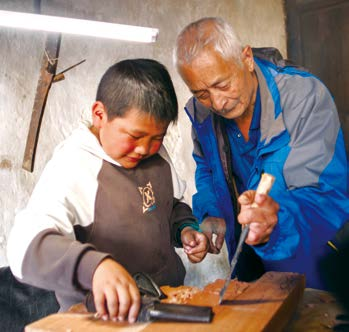
Yang Ling (right), a revered master carpenter in Zhoucheng Village
has carved Buddhist statues and built houses across Yunnan Province.
Here, he guides a young learner.
Zhoucheng and Shangguan are two well known ancient villages in Yunnan Province where local customs and handicrafts serve as roots of culture. Our partner Dali Lanxu Culture Centre has been working since 2022 to facilitate intergenerational interactions in the two communities. Elderly villagers hope to transmit heritage, affection and connection with homeland, and reverence to nature, while youth seek to deepen their cultural understanding and pursue sustainable living.
In Shangguan, an elderly association and women's group worked with village officials in reviving Longtan, a traditional farming cultural activity, in 2023 and 2024. Shangguan honours Longtan, with its sense of cooperation, and respect of nature — the term literally means 'dragon pool'. Youth have experienced and learned about this ancient mechanism that has ensured an efficient distribution and management of water resources in Shangguan, where water has often been insufficient, if not scarce. With trends of farmland being converted into non-agricultural land, however, traditional culture in Shangguan has begun to wane. It remains a question as to how well Longtan can continue to shed light, and insight, for addressing today's environmental and development problems.
A famous village, Zhoucheng is called a 'living fossil' of Bai culture. Traditional handicrafts such as tie-dye, incense making and embroidery all use local natural materials. Intricately connected with village ecology, these crafts also carry people's life stories and the village's collective memory. Lanxu supported local youth to interview ten elder artisans; the stories eventually featured in an exhibition that yielded meaningful interaction among generations. Lanxu has planned to go further, with youth and elders further discussing connections between handicrafts, ecology, farming culture and rural life. In this sense, artisans are bridges, linking people with homeland.