
Ho Wai Ki, an experienced social worker, works with the Christian Concern for the Homeless Association as their Research and Development Supervisor. His 17 years of service with homeless people has convinced him that only holistic care can meet the needs of this social group. Although non-governmental organisations have been mobilising substantial resources in areas such as emergency support, emotional counselling and welfare service referral, most of the support caters to basic immediate needs. Wai Ki believes that only with long-term support in place that takes care of social needs can homeless people regain hope for a new chapter in life.
“We care about the situation of homeless people,” he says, “but merely providing charity services or assistance is far from enough. We need innovation in our work. We need to trust in the synergy of efforts with different sectors. With this expectation and with the support of the organisation I work for, I joined the NGO Changemakers Incubation Scheme.”
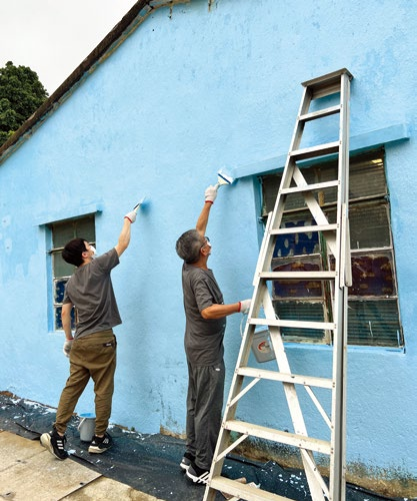
People experiencing homelessness volunteer to help maintain the homes of elderly people in the countryside.
The Scheme, a collaboration between PCD and the Hong Kong Council of Social Service (HKCSS), has three components: training in design thinking, cross-sector placements, and exchanges with community organisations. The short-term aim is to enable participating social workers to have the opportunity to learn, reflect, build networks, and co-create with various actors for a deeper understanding of various concepts and work approaches. In the long term, we hope to nurture innovative seeds within organisations that ultimately grow into benefits for society.
Wai Ki’s placement, during the Scheme’s annual theme of food and social inclusion, was with Sustainable Ecological Ethical Development Foundation (SEED). He knew little about farming at the start, saying, “I originally thought that the placement was about farming, talking with farmers, visiting farms and promoting organic farming... As time went on, I began to feel the experience in my heart. Knowing that we have to rely on nature’s care for farming, one feels humble and relaxed. When I connect with farmers and receive the selfless sharing of their harvests, I feel the sincerity of their care. When I witness the growth of crops planted by my own hands, happiness and a sense of satisfaction naturally arise in my heart. It is a pity that the grassroots in this city may never have an opportunity to experience farming, especially people whose abilities are not being recognised in the job market, including the unemployed.”
Connections with SEED continued after Wai Ki’s placement ended. Over the past year, Wai Ki has brought ten homeless people from Sham Shui Po to visit SEED every month. The participants have developed friendships with SEED volunteers that have made them feel they are not alone. Most importantly, they have rediscovered their self-worth through these interactions.
Wai Ki considers homeless people as “hidden assets” with a huge array of skills. Indeed, they have since formed themselves into volunteer groups, providing repair services, making dim sum for elderly people in Hong Kong’s more rural areas, and setting up a core team of volunteers to help at the farm in their free time.
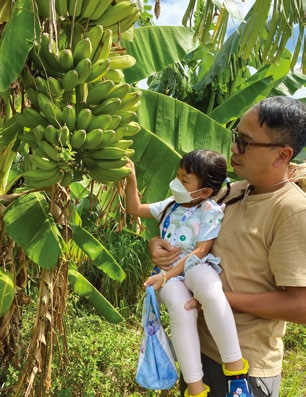
In his spare time, Ho Wai Ki brings friends and family to experience the countryside as a way to connect with nature.
Wai Ki values SEED for remaining committed to and accommodating of people of different backgrounds. Indeed, SEED has employed one homeless participant who regularly joined activities. “This worker was once an alcoholic,” Wai Ki says, “and after he stopped drinking, his mental health greatly improved.” With a part-time job, he will soon move into transitional housing near the farm – a huge and encouraging life shift.
Connectivity is a key value: it is the driving force behind Wai Ki’s work. He particularly values community networks, knowing that the synergy created has much more potential than the services and activities offered by any single organisation. The placement experience has reaffirmed Wai Ki’s belief in holistic and humanistic care for homeless people. “Exchanges among organisations are very often goal-oriented. Yet a sense of connection within a community is another thing. It is not functional, rather it’s about cultivating the human touch that every person needs.”
* Excerpted from Annual Report 2022-2023